


Discover & explore nearby places
A story of a social app startup with a small userbase.
Results
- Increased user retention
- Monetizable solution
- More stable & manageable app
Company
Amici
Time frame
2 months
Role
Lead UI/UX designer, User research, Ideation, Prototyping, Pitch deck, Business strategy
Background & context
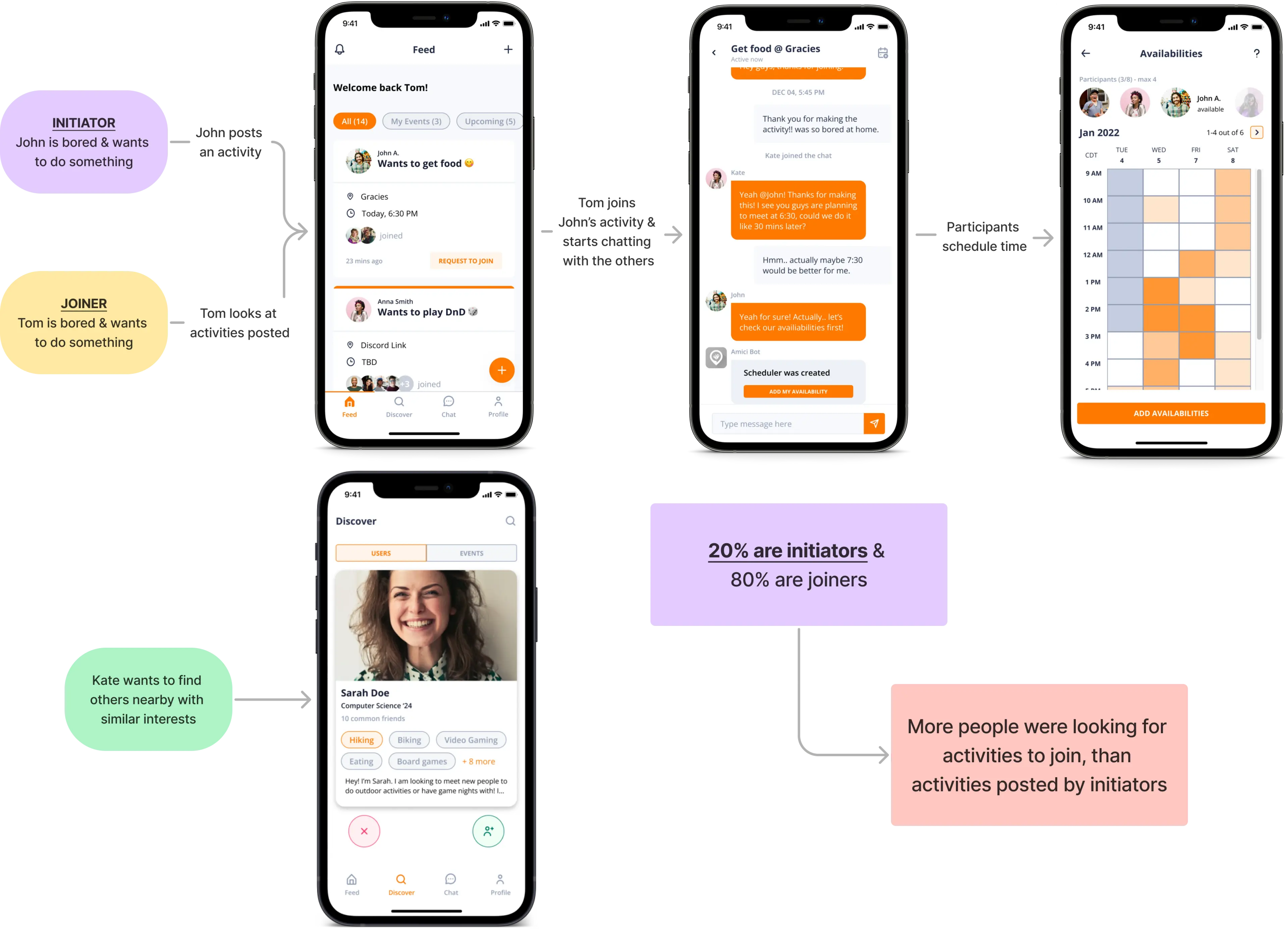
The initial app had 4 core features & relied on the 20% of users who initiated activities to remain active
The Problems & Goals
Solving the problem of keeping the app going with few active users and lots of bugs to achieve business and user goals
The goal
Take a new direction on helping more people spend more time outside, while strategically benefiting our business growth.
Profitable & working solution
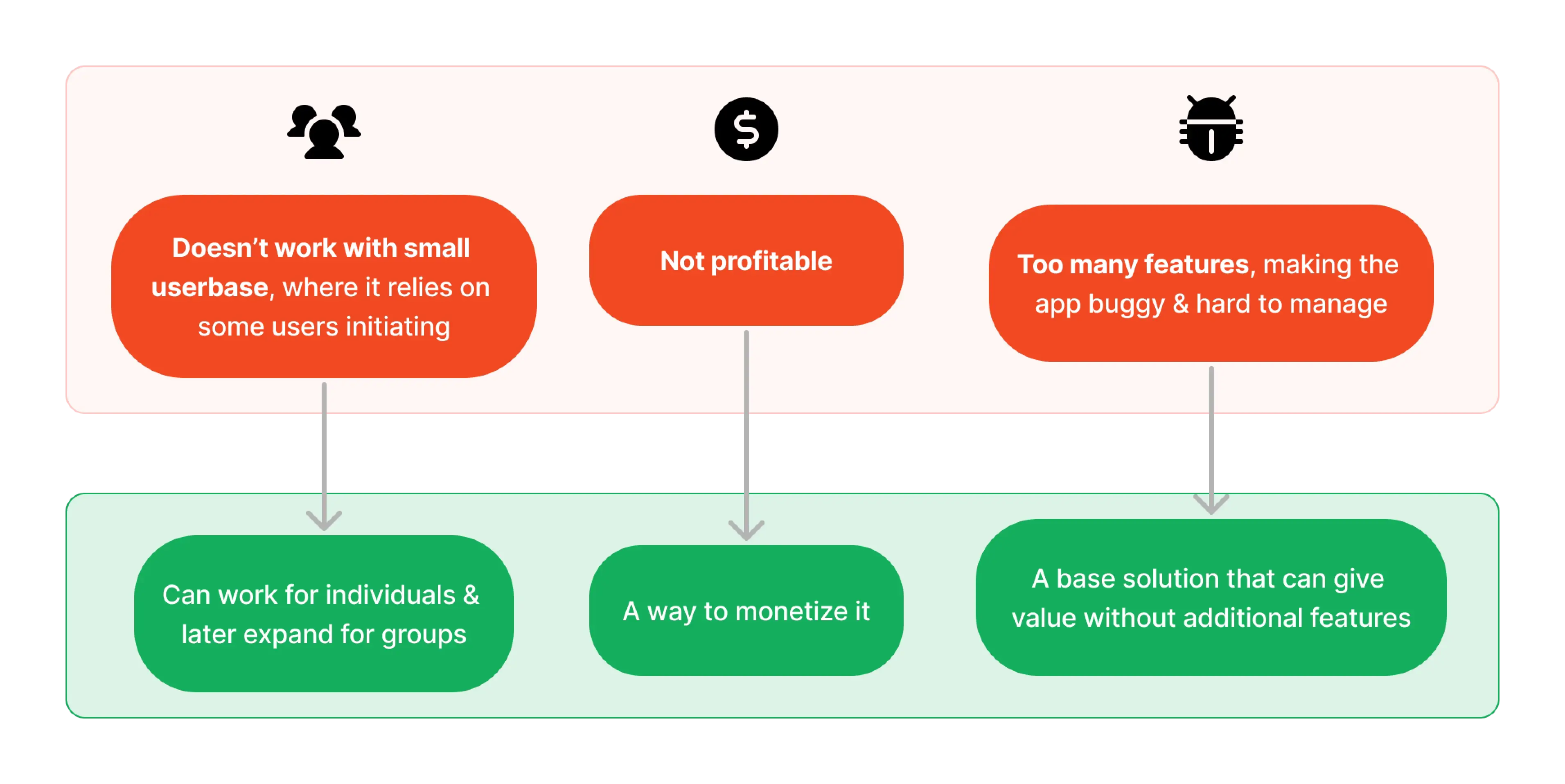
Sharing activities to join doesn't have easy monitization possibilities, nor was it successful at solving the problem. So I decided to take a step back and find a better solution that can also be profitable.
Wider user base
We were concentrating on college students, and the app was only useful for groups of strangers. I decided to find a solution for a wider range of people that could work for individuals as well as for groups.
Stable app
The current app had too many big features that were hard to maintain as they were buggy. In the new solution, I wanted to focus on keeping the features small but still valuable.
Research
Pre-existing knowledge of three motivators drove the design of a survey to measure user desires and support needs for outdoor activities
Through Discord discussions and in-person app testing, I identified three essential motivators for users to get outside: social interaction, engaging in specific activities, and visiting desired locations.
I designed a survey using 1-5 scale statements, both positive and negative, to mitigate bias and enhance accuracy. I aimed to accurately gauge users' desire for these experiences and their perceived need for help in achieving them.
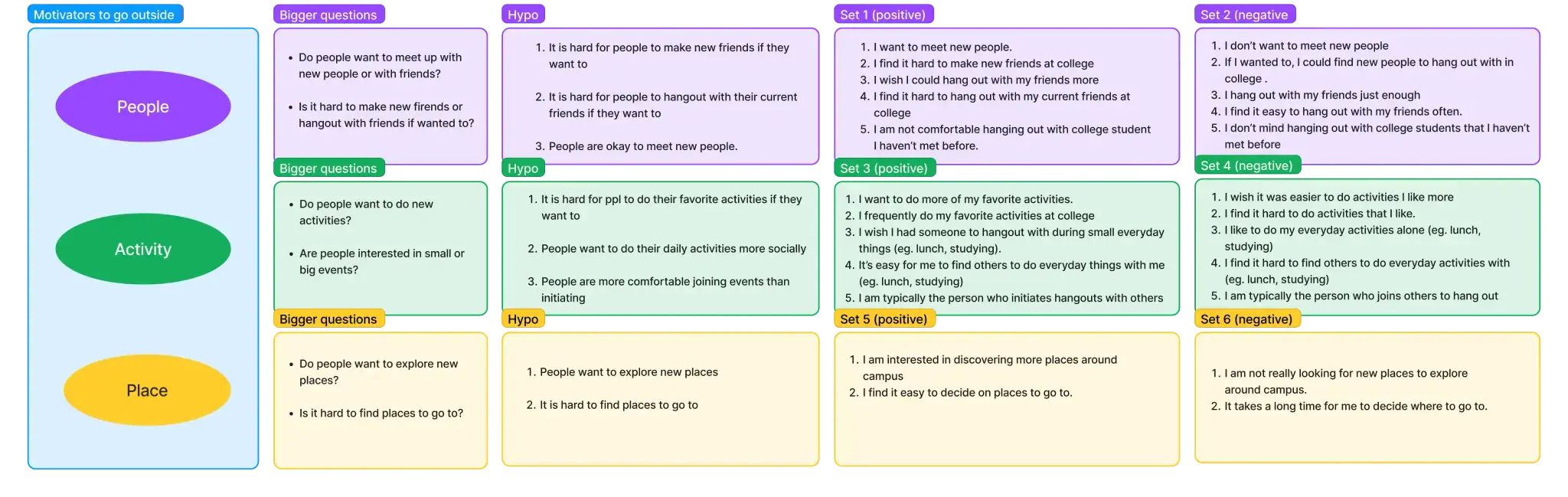
The research questions based on the different motivators
Key findings
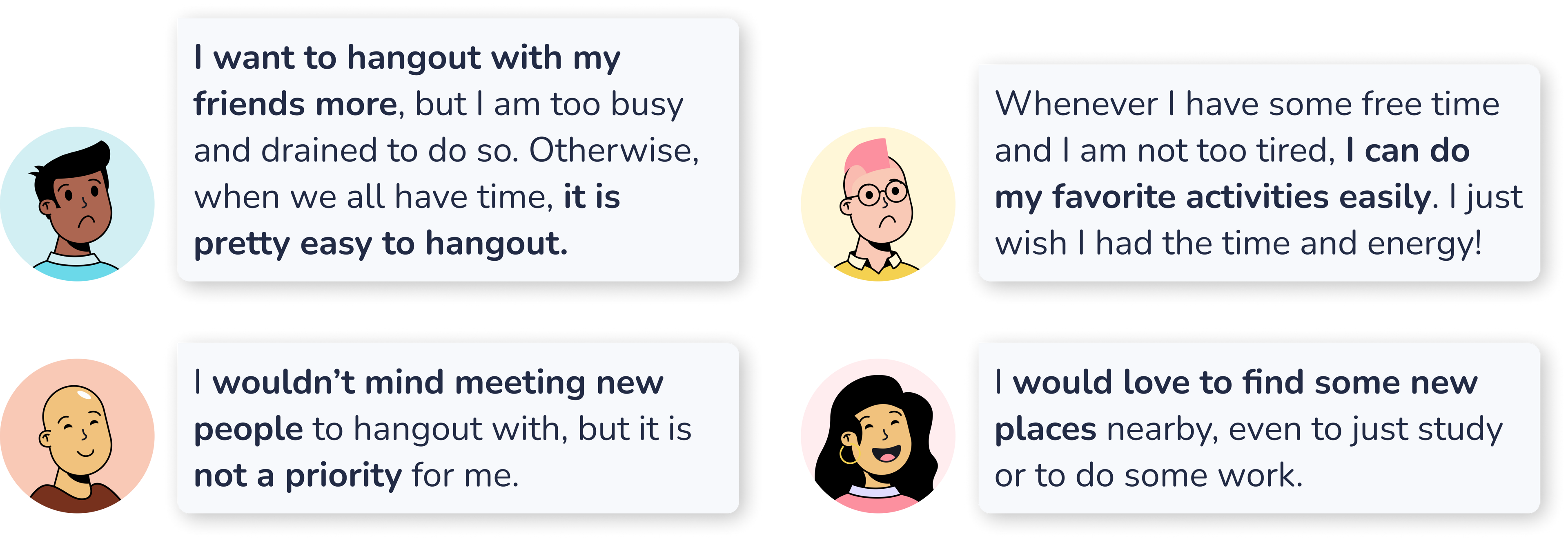
People are fine with socializing and activities, but their main problem is time constraints. However, they want help to discover nearby places.
I reversed scored the negatively phrased items, and combined it with the positive ones. I took averages and did some further calculations. From that and the qualitative results I found that people would like to hangout with friends and do their favorite activities more, they don't need help figuring out the "who" and "what" because their biggest obstacle is lack of time. However, they are interested in exploring new nearby places and would like to receive help finding those spots.
Deciding on the problem to solve
Evaluating the impact of solutions to different problems based on user and company needs
Criteria 1: Which motivator solves the project and company goals?Would it work with a small userbase, and if it can be profitable in new ways.
Criteria 2: Which problem could work without solving the other ones the most likely.
Results: From this activity, I found that the "where to go" problem would align with the project and company goals the most, while also be the most likely to work without solving the "who to hangout with" and "what to do" problems.
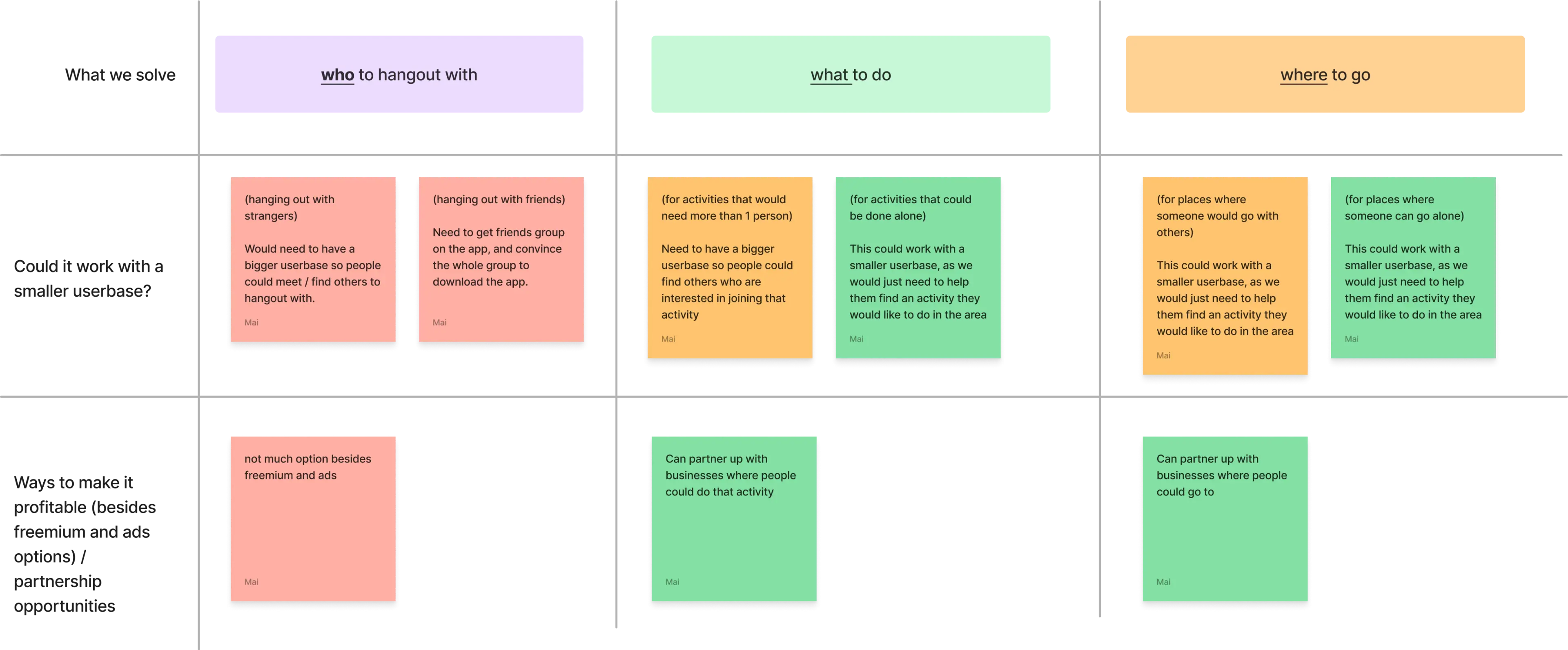
Evaluating each of the possible problems against the project goals
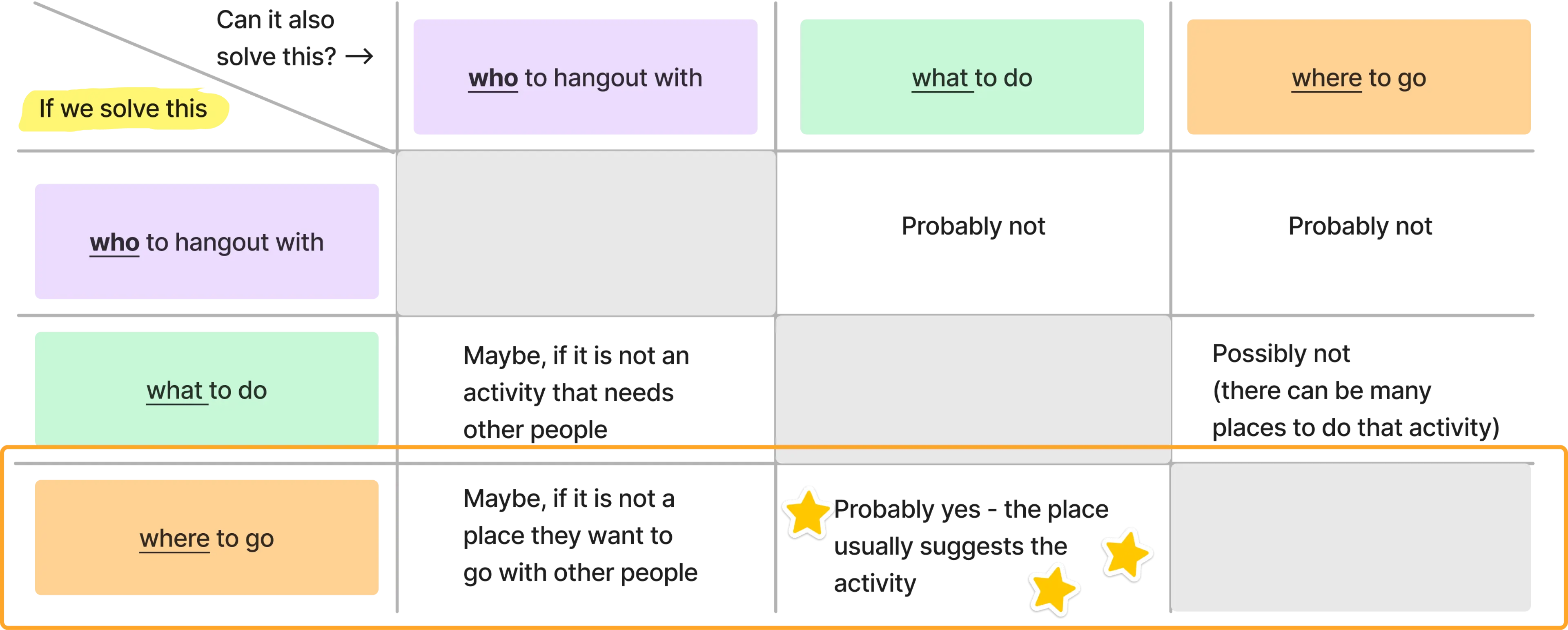
Solving the "where to go" problem seems to be the best stand-alone solution
The problem-to-solve
The quest became to solve the "where-to-go" problem
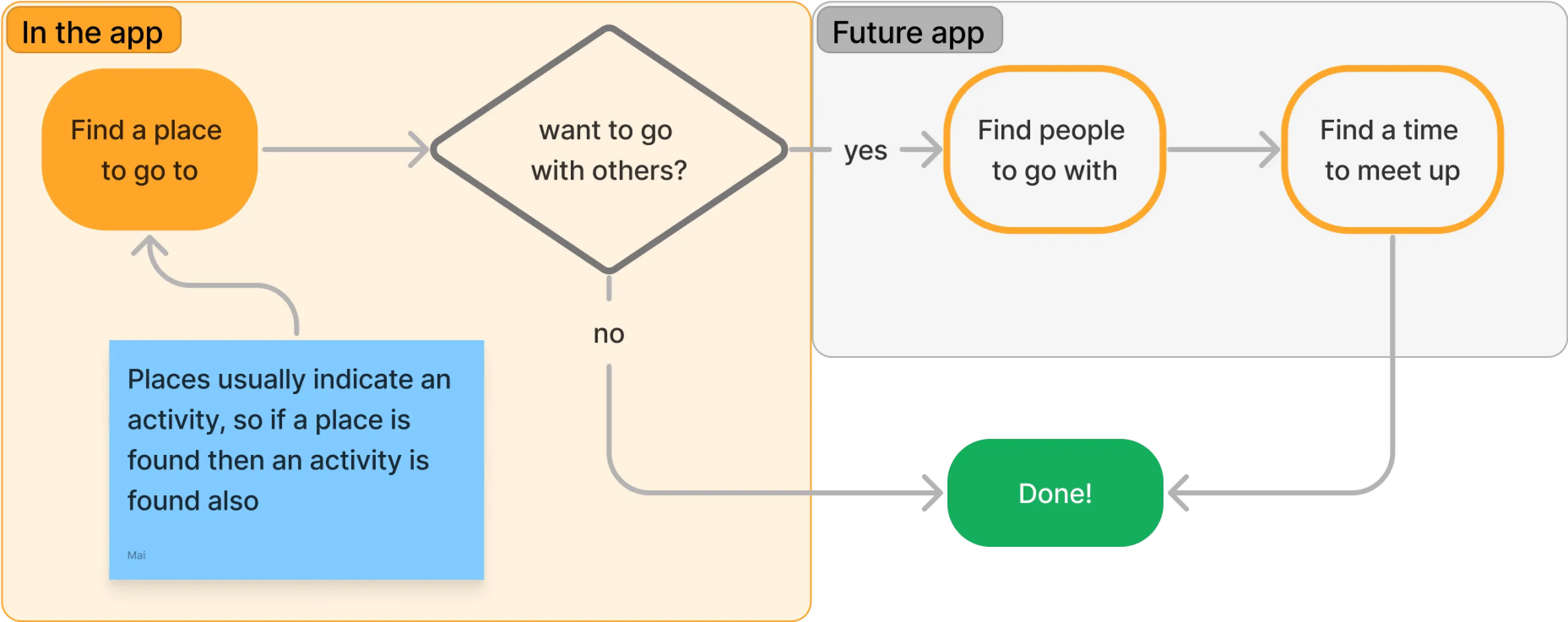
Target users
Decided to start by focusing on individuals, aiming to expand the app's features for groups as more users join
Based on the project goal of creating a solution that could work with a small userbase, I wanted to focus on individuals specifically. However, as the goal is to connect people together, making it into a social app, I also wanted to come up with a solution that could potentially work for groups as well. First, for group of friends so we could grow our userbase, and then for group of strangers once the userbase is big enough.
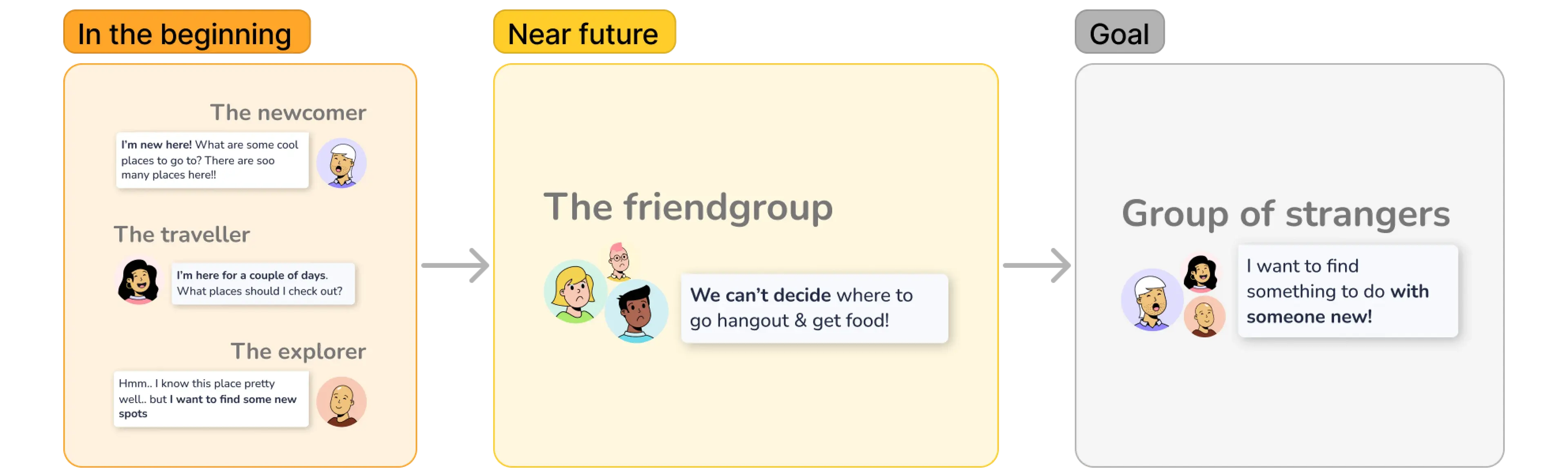
Our target users
New app idea
I aimed to create a new app, similar to the original but with place-swiping, suitable for both group and individual use, then simplifying it for an MVP
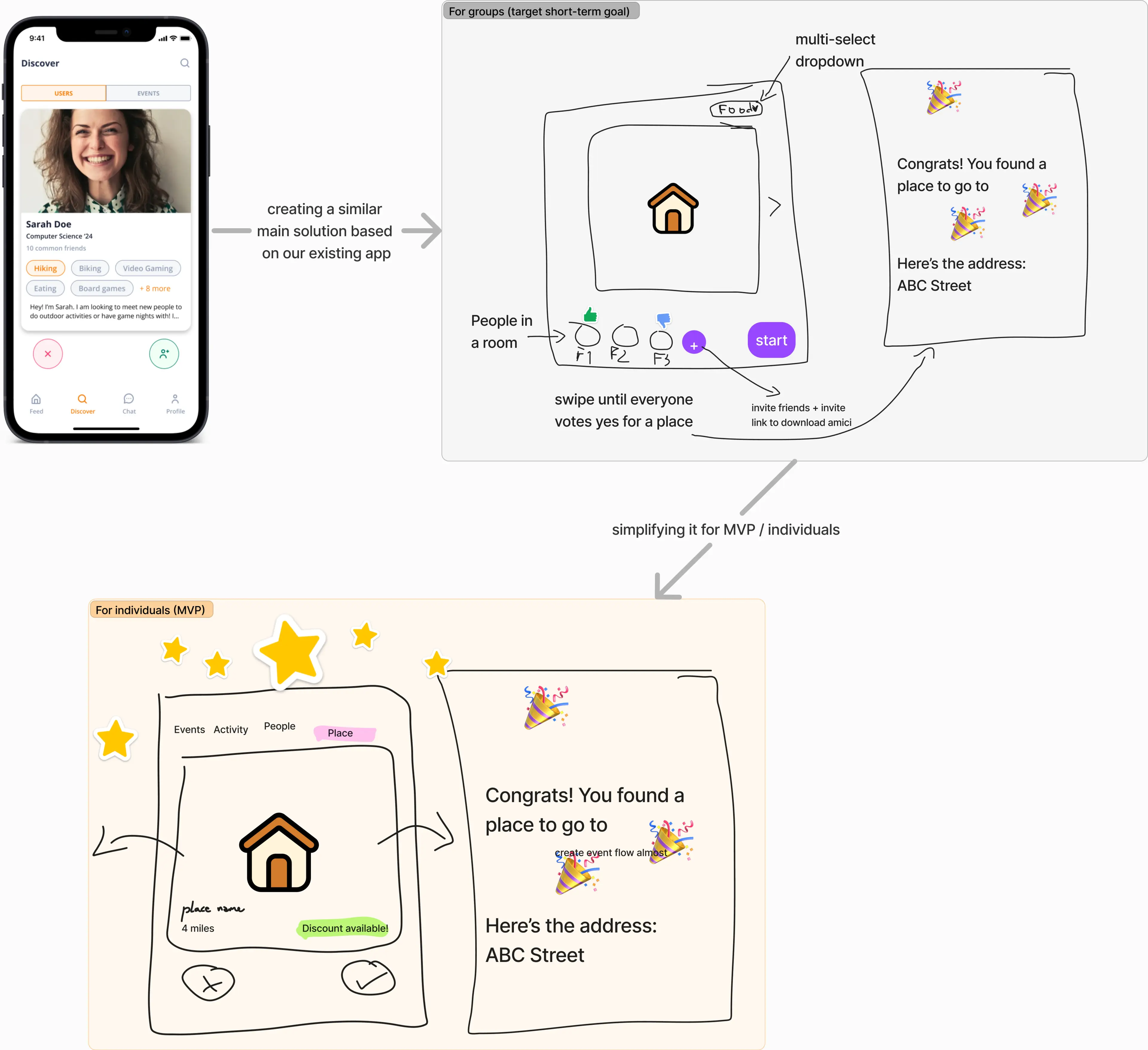
Brainstorming features
Brainstormed possible features and selected out the most necessary ones for an MVP
I listed out possible features that I would like to include in the app, no matter how crazy it might be. Then color coded them based on which ones to include in the initial app (green), ones to do right after (yellow), and ones that we could possibly do in the future (gray). These decisions came down to what helps the goals the most and what are crucial features to make the app even work.
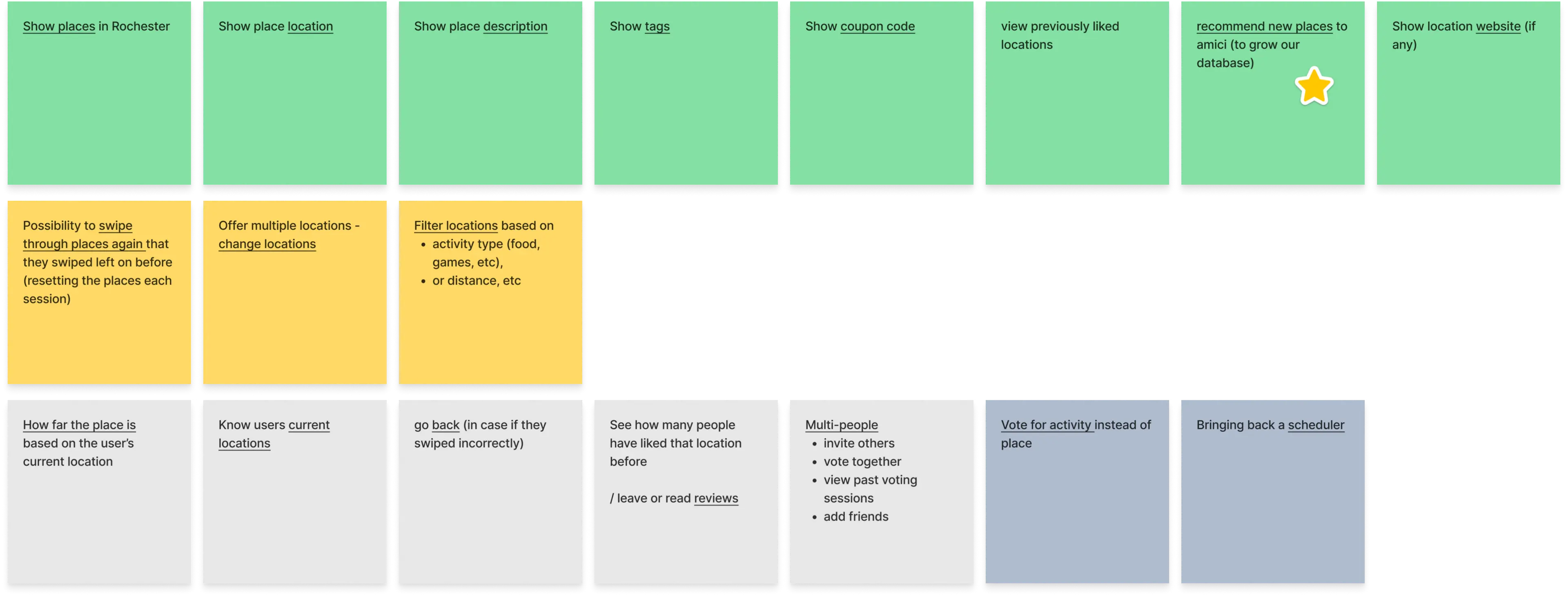
Our target users
Final MVP
3 simple core pages to start our renewed app
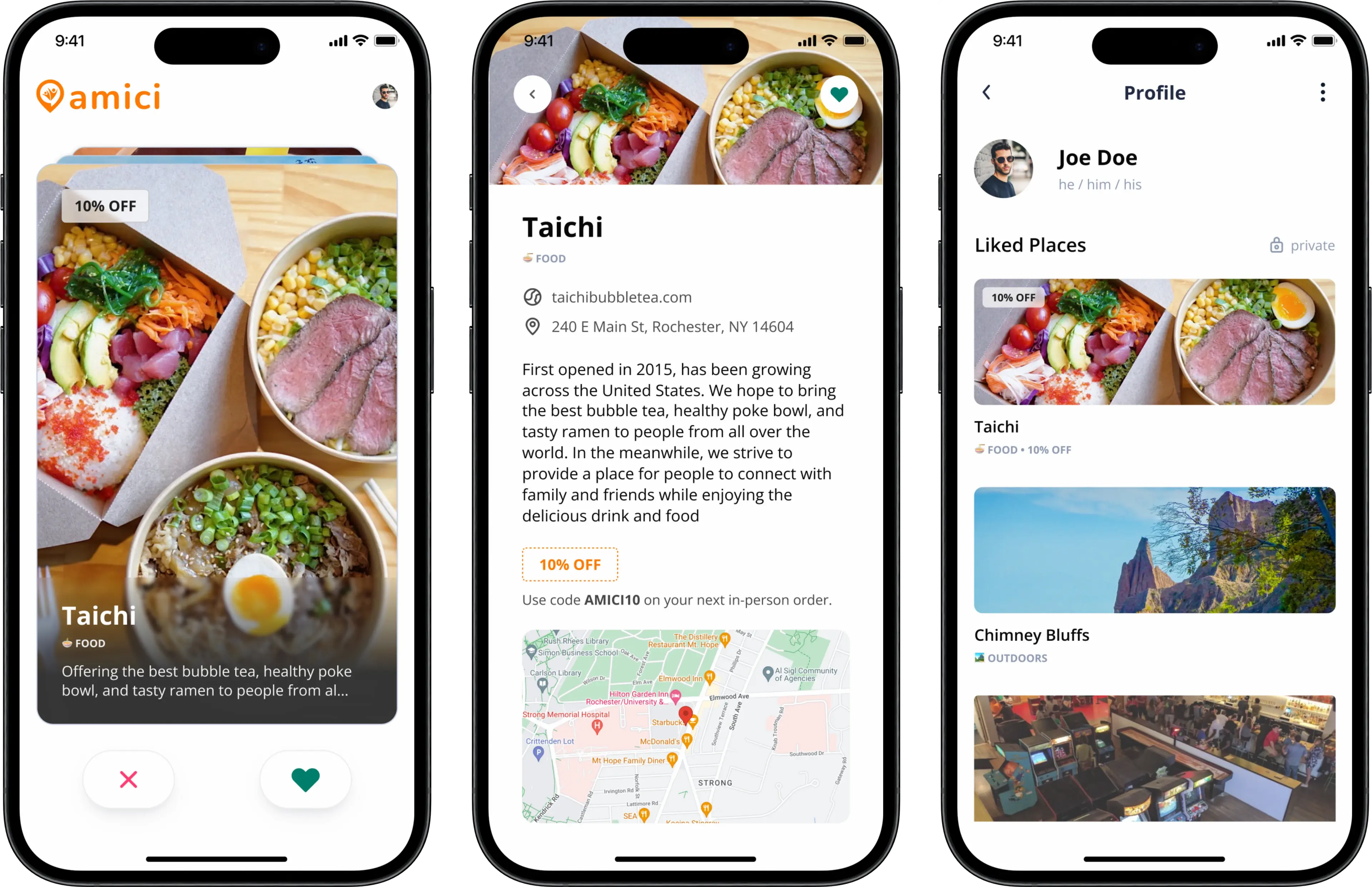
In the end, based on the user flows and feature ideas, I created 3 new pages: the swiping page, the place details page, and the profile page. While the onboarding and settings pages would remain the same as in the original app.
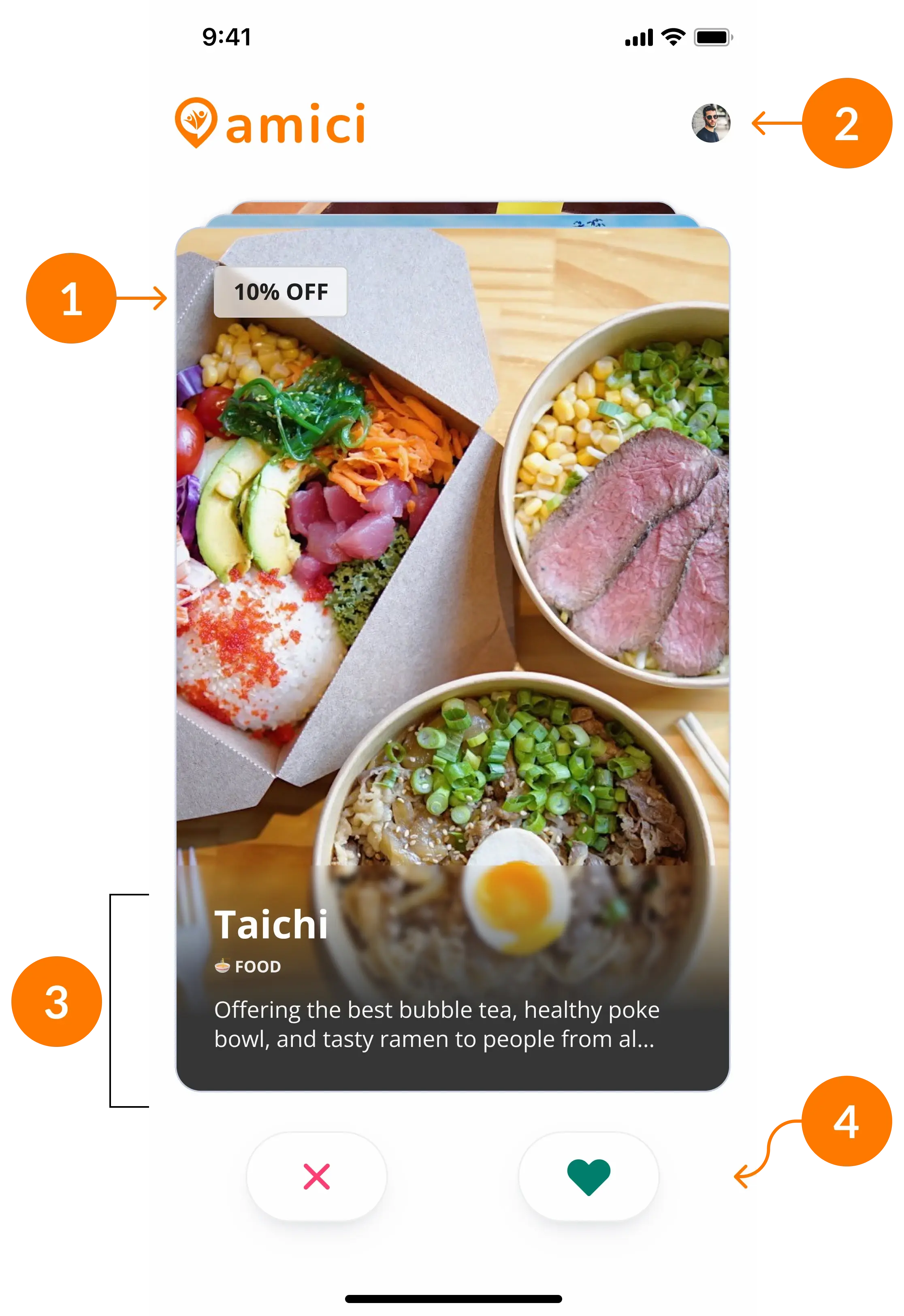
The main page: swiping through pages
- Coupon discount: if there is partnership between Amici and the place. This is benefiting our company goal
- Button to profile page where they can view the places they liked in the past
- Essential information that can help people make a decision at first glance:
- name, image, type, 2 line description
- Button to like or dislike a place: in case if they are not familiar with the swiping behavior
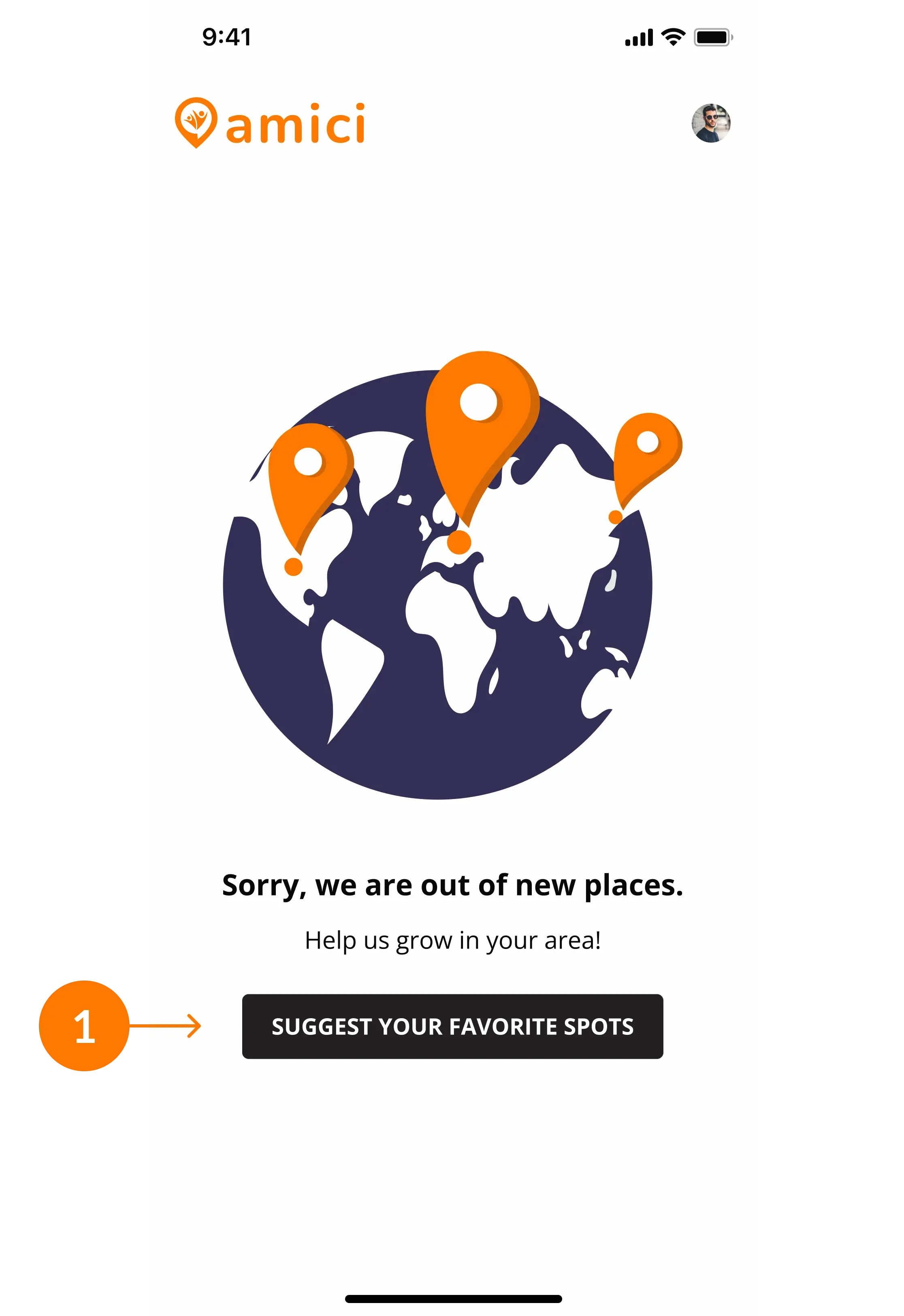
Empty state: when there are no cards left
- CTA to submit other places in the area: this can help us grow our database; it is linked to an external google form
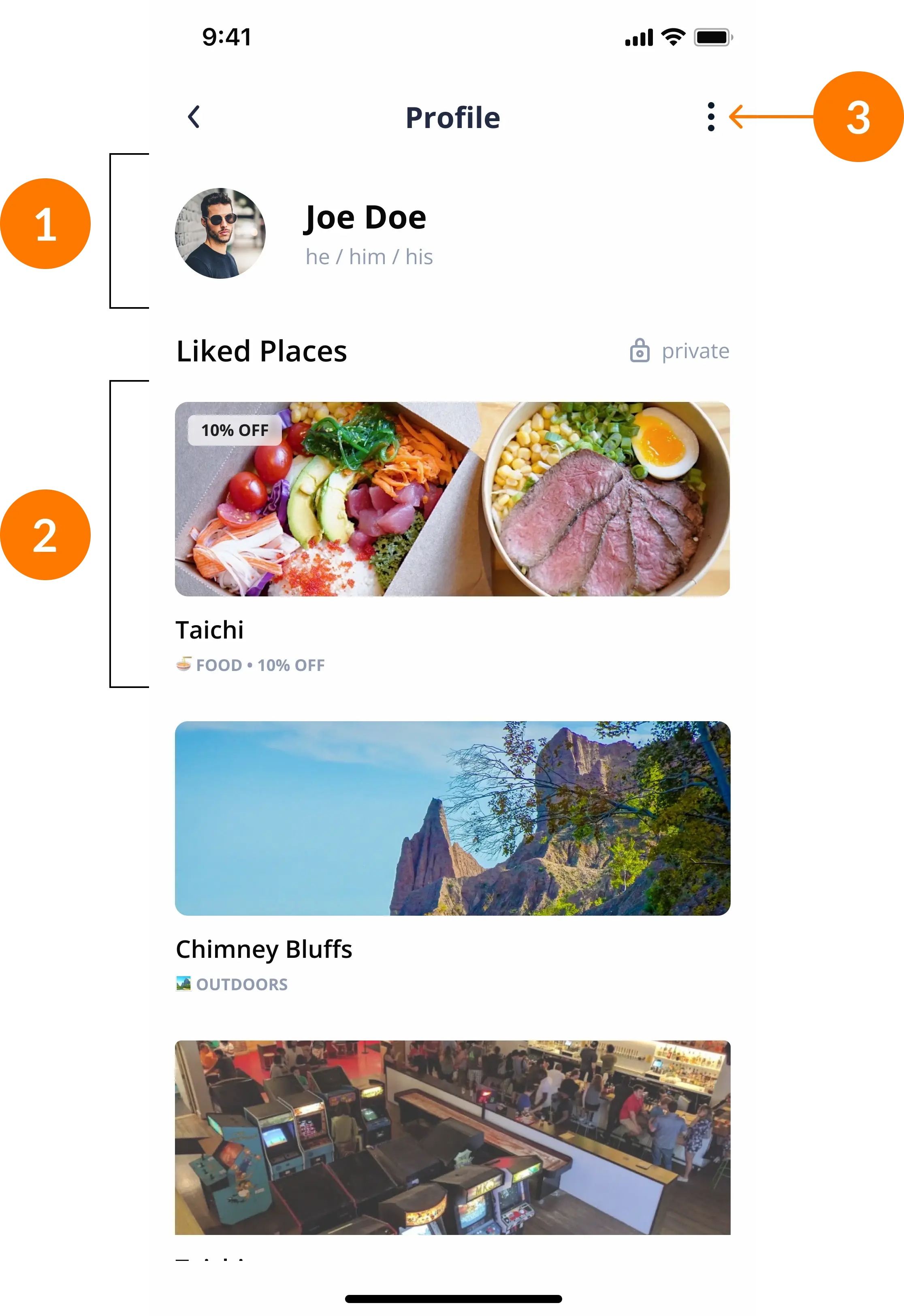
The profile page: view the liked places
- Basic profile information: name and pronouns -- these are information that we have already been collecting from the original app
- Smaller place card's basic information:
- name, image, type, discount availability
- Button to profile settings: we already have those screens from the original app
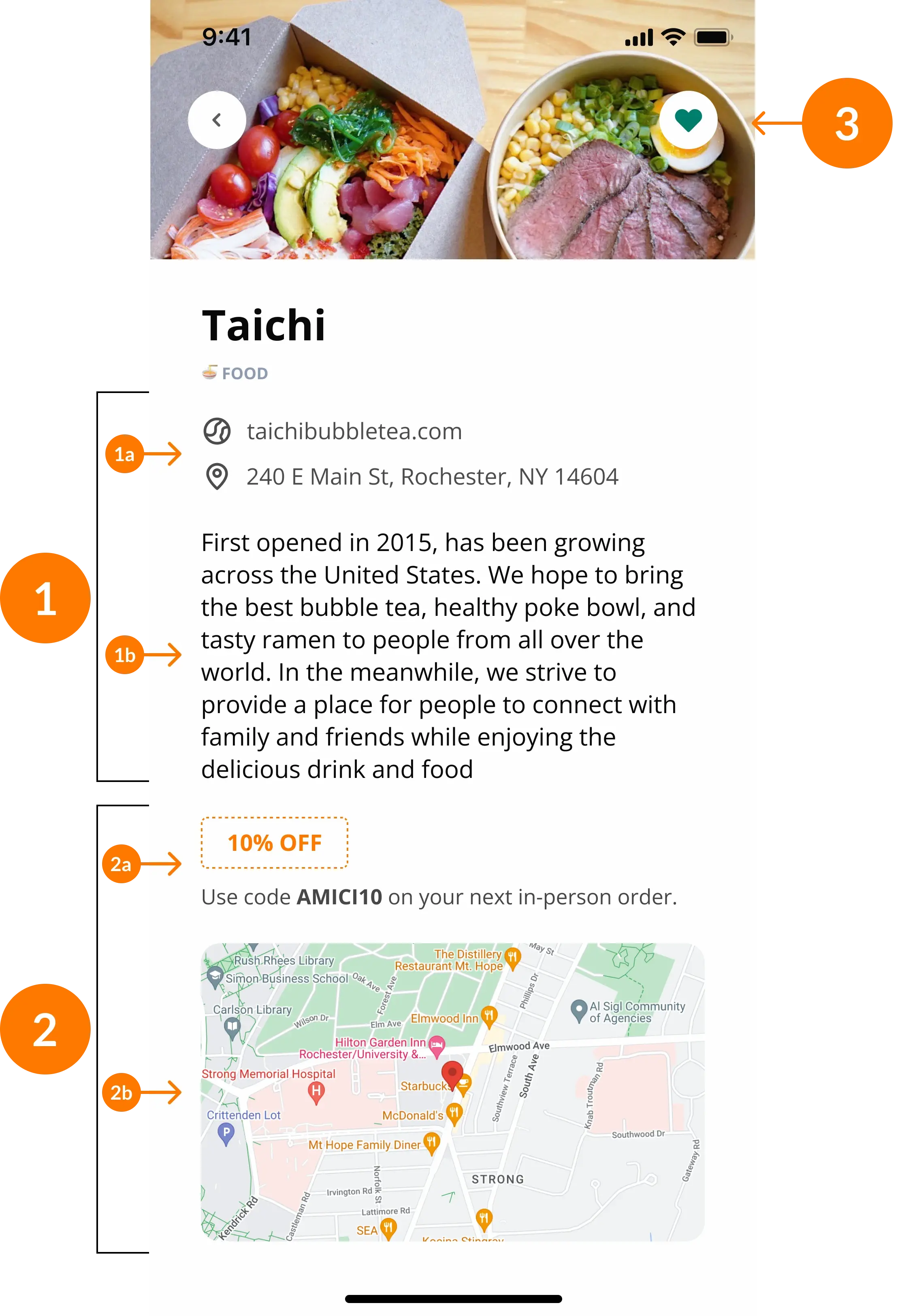
Place page: more details about a place
- Iformation that can help the user decide if they are interested:
- Website & location: external links to learn more about the place
- Longer description that is not limited to 2 lines
- Information that can be useful once the user is at the place - placed lower, since the user doesn't need these information really until they go to the place
- Coupon code: once they are at the place, they would look here to find the code
- Map: a way to view the location within the app
- Like / dislike button: indicating if the place is currently liked, and a way for the user to change it
Outcome
A new solution satisfying all our goals
Monetizable solution as we can partner with some of the places on our app
This solution works for individuals and non-initiators, as well as in the future for groups
The app became more stable, as the features were kept small and there were less bugs present
Learnings
When creating a startup solution, it is crucial to consider the initially limited number of active users
Ultimately, the fundamental issue with Amici was its reliance on a large number of active users in a specific area, making it less useful for a new app with a small user base. This experience taught me the importance of creating a solution that is valuable even with just one user initially, encouraging subsequent user growth through referrals and populating the app for future enhancements.
I also learned that it is okay to question the initial solutions and ideas that are given to you as a designer. Just because someone came up with an idea and made it into the end goal, does not mean that it also has to be the start of the journey or that it is beneficial for the company or the users.